The Future Of WhatsApp Marketing In 2026
You know that feeling when you’re getting leads… but they just don’t reply?
Or worse — they reply once and then disappear like they never existed.
Yeah. That’s been happening a lot.
And most people assume the problem is their offer, or pricing, or maybe even the audience. But honestly, that’s not always it. A big part of the problem is how communication is handled after the lead comes in.
That’s where The Future of WhatsApp Marketing in 2026 starts getting interesting.
Things are shifting. Quietly, but fast.
In this article, I’ll break down what’s actually changing, what people are still doing wrong, and how businesses are adapting (some smartly, some… not so much).
Let’s be honest — WhatsApp has moved way beyond simple chatting now.
A lot of blogs will still tell you WhatsApp is for “customer communication.”
That’s outdated thinking.
Now let’s be real for a second.
WhatsApp has turned into a full-on sales system. Not officially labeled that way, but that’s exactly what it is becoming.
- Lead qualification
- Follow-ups
- Automated responses
- Payment links
- Even customer retention
Everything is happening inside one thread.
And if you’re still using it like a basic messaging app… you’re already behind.
What’s Actually Changing in 2026
Let’s not overcomplicate this. There are a few big shifts happening, and everything else is just noise.
1. Automation is no longer optional
Earlier, automation felt like a “nice-to-have.”
Now? It’s survival.
Businesses are slowly realizing that manually replying to every lead is just not scalable. Especially if you’re running ads.
That’s why you’ll see more people moving towards systems where:
- Instant replies are triggered
- Leads are filtered automatically
- Follow-ups happen without human effort
This is where how businesses are scaling with WhatsApp automation becomes a real topic, not just a trend.
And yeah… some people overdo automation and make it robotic. That’s a mistake. But not using it at all? Bigger mistake.
2. Speed matters more than persuasion
People don’t wait anymore.
Even if your message is really strong… it won’t matter if it reaches late. Doesn’t matter if it comes 20 minutes late.
Most conversions now happen in the first 2–5 minutes.
Miss that window… and your lead is probably already talking to someone else.
That’s where most people get it wrong.
They focus on writing “perfect replies” instead of building a system that replies instantly.
3. Broadcasts are getting smarter (and stricter)
Broadcast messages used to feel like spam. Honestly, sometimes they still do.
But things are changing.
Platforms are becoming stricter about:
- Consent
- Message quality
- Frequency
So you can’t just blast offers anymore and expect results.
You actually need to send messages people want to open.
Sounds obvious. And honestly, most people still get this wrong.
WhatsApp API vs Regular WhatsApp (the real difference)
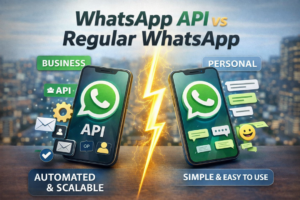
This part confuses a lot of beginners.
Let’s simplify it.
| Feature | Regular WhatsApp | WhatsApp API |
|---|---|---|
| Automation | Very limited | Full automation possible |
| Multi-user access | No | Yes |
| Broadcast limits | Small | Scalable |
| CRM integration | No | Yes |
| Setup difficulty | Easy | Slightly technical |
Now let’s be honest.
Most small businesses start with regular WhatsApp. That’s fine.
But the moment you start running ads seriously… you hit limitations fast.
That’s where the whole WhatsApp API vs regular WhatsApp conversation becomes real.
Not because API is “better,” but because regular WhatsApp simply can’t keep up after a certain point.
Why Most Businesses Still Struggle (Even in 2026)
You’d think with all these tools, things would be easier.
But no.
People are still stuck.
Here’s why.
They treat WhatsApp like a support tool
They wait for customers to ask questions.
Instead of guiding the conversation.
Big difference.
They reply like humans… but too slowly
Ironically, being “human” is good.
Being slow is not.
There’s a balance. And most people miss it.
They don’t build flows
Everything is manual.
Every lead = fresh conversation.
That’s exhausting. And inconsistent.
Smart businesses create flows:
- First message
- Qualification
- Offer
- Follow-up
Same structure. Every time.
What Smart Businesses Are Doing Differently
Now this part is interesting.
Because the gap between average and smart businesses is getting wider.
1. They design conversations, not just replies
Instead of reacting, they plan:
“What should happen after this message?”
It’s almost like scripting a journey.
2. They mix automation with human touch
Not everything is automated.
And not everything is manual.
They automate the boring parts…
…and step in when it actually matters.
3. They track what’s working
Most people don’t.
They just “feel” like something is working.
Smart businesses actually check:
- Response rates
- Drop-off points
- Conversion timing
Small tweaks. Big difference.
A small truth people don’t like hearing
More messages ≠ more sales.
I’ve seen businesses sending 10 follow-ups.
Still no conversion.
Why?
Because the first message itself was weak.
Or irrelevant.
Or too generic.
Honestly, sometimes it’s just bad timing.
Fixing that matters more than adding more messages.
Where This is All Heading
Okay, so what does The Future of WhatsApp Marketing in 2026 actually look like?
Not some fancy AI takeover.
Not fully automated bots running everything.
It’s more practical than that.
- Faster replies
- Smarter flows
- Cleaner conversations
- Less spammy behavior
And honestly… better user experience.
That’s it.
The businesses that win will be the ones that make things easier for the customer.
Not louder.
Should You Change Your Strategy Right Now?
Short answer: probably yes.
Long answer…
Depends on what you’re doing right now.
If you’re:
- Manually replying to every lead
- Missing responses
- Sending random follow-ups
Then yeah. Something needs to change.
But don’t overcomplicate it.
Start small.
Fix speed first.
Then structure.
Then automation.
Soft CTA (No pressure, just a thought)
If you’ve been feeling like your leads are “not serious,” maybe it’s not the leads.
Might be worth looking at how the conversation is handled.
Sometimes a small setup change makes a big difference.
FAQs
1. Is WhatsApp marketing still effective in 2026?
Yes, but only if done properly. Slow replies and random messaging don’t work anymore.
2. Do I need WhatsApp API to grow?
Not immediately. But once you scale ads, it becomes almost necessary.
3. How fast should I reply to leads?
Ideally within 1–3 minutes. After that, chances drop quickly.
4. Can automation feel natural?
Yes, if written properly. Bad automation feels robotic. Good automation feels helpful.
5. How many follow-ups are too many?
More than 3–4 without value usually becomes annoying.
6. Is broadcast messaging still useful?
Yes, but only when it’s relevant and permission-based.
7. What’s the biggest mistake people make?
Treating WhatsApp like a casual chat instead of a structured system.
Conclusion
Things aren’t getting complicated for no reason.
They’re just evolving.
And honestly, that’s a good thing.
Because the basics still work — speed, clarity, relevance.
That’s what The Future of WhatsApp Marketing in 2026 really comes down to.
If you focus on those three… you’ll already be ahead of most people.
No fancy tricks needed. Just better execution.